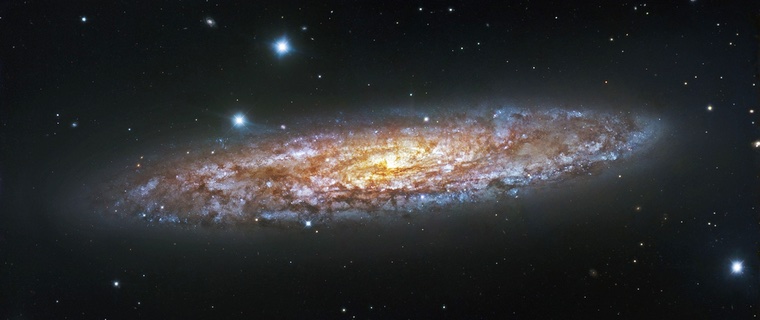
 Up to OJB's Objects List Return to Previous Page Sculptor Galaxy
NGC 253 is a bright, easy edge-on galaxy in Sculptor at about 25 degrees south. It is also known as the Sculptor Galaxy or the Silver Coin Galaxy. It is easy and quite detailed in a 36 cm (14 inch) telescope and showed unbelievable detail when viewed in the 1m (40 inch) telescope at Mt John (Canterbury, New Zealand) with several dust lanes visible. The distance of this galaxy is 8 million light years, making it close by the standards of galaxies. The visual brightness is magnitude 7.1 and the size is 25 x 7 arc minutes. Location is 0h 47.6m right ascension, -25° 17m declination. The galaxy is about 7 million light years away and total apparent length is over 30 arc minutes. Even a 7.5 cm telescope will show an obvious elongated blur. A 30 cm will show darker areas and the 1 m reveals detailed structure in the dark lanes but because of the size of the object only about a quarter of it could be viewed at once (the Mt John telescope has quite a long focal length at the Cassegrain focus). 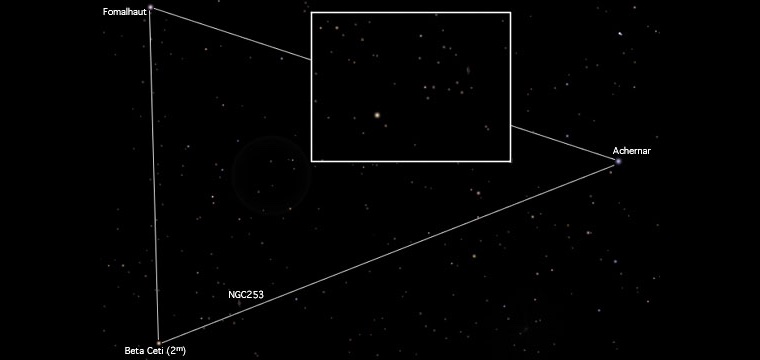 To find this galaxy first locate the bright stars Achernar (the ninth brightest star, magnitude 0.46) and Fomalhaut (the 18th brightest, magnitude 1.16). They form a large triangle with the second magnitude star Beta Ceti. Now use the smaller map above to locate the galaxy. Note that the bright star on this chart is Beta Ceti and the oval smudge is the galaxy. Search from Beta Ceti for the two distinct groupings of stars shown above. The first group is a triangle and the second is a kite shape. The galaxy is located just beyond the second group, as you can see on the chart. 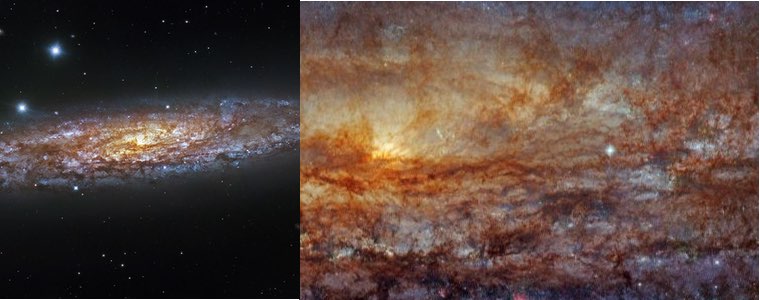 These pictures show the central area of the galaxy. NGC253 has a lot of dust in it so the dark dusty areas are a prominent part of photos and also show a lot of detail during visual observations, especially with larger telescopes. The image on the right is from the Hubble Space Telescope and is composed of several smaller pictures joined together.
| ||||||||||||||||||||||||||||||||||
 OBJECT PAGE