 Up to OJB's Objects List Return to Previous Page Tarantula Nebula
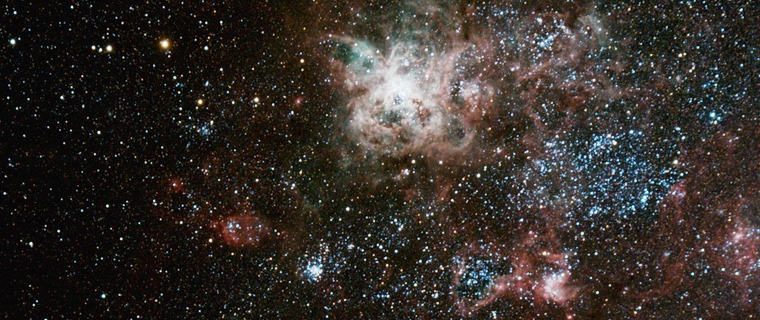
The Tarantula nebula (NGC2070) is really big, but because its at such a great distance (in the Large Magellanic Cloud) it doesn't appear as big as Eta Carinae. It does have interesting detail and is easy to find right in the middle of the Large Magellanic Cloud, 70° south. Oh yes, you have to be in the southern hemisphere to see this one too! Easily visible to the naked eye. The Tarantula Nebula is also known as NGC 2070 and 30 Doradus and is embedded inside the Large Magellanic Cloud around 180,000 light years away. Its a very large object, apparently about 0.6 degrees across which corresponds to a true diameter of 1700 light years. The visual magnitude is around 8.  In the images above I have attempted to show what the nebula looks like through different telescopes, varying from binoculars to a smaller telescope (approx 6 inch, 15 cm) and then to a larger telescope (14 inches, 36 cm). Trying to portray what is seen visually from a photo is somewhat inexact, its especially hard to know how far from the center of the object is really visible, but I hope these give you an idea of what amateur telescopes can do. 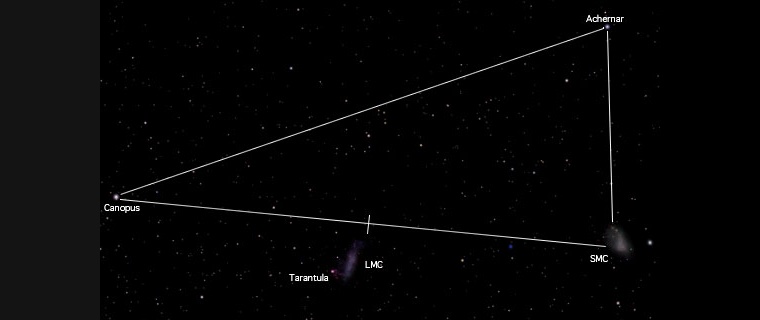 This is how to find the Tarantula Nebula. First find the bright stars Canopus (a supergiant of over 15,000 times the Sun's brightness and the second brightest star in the sky) and Achernar (the ninth brightest star). These form a right angle triangle with the Small Magellanic Cloud as shown above. The Large Magellanic Cloud is half way along the bottom of the triangle. Embedded in the Large Macgellanic Cloud is the nebula. It should appear as a brighter area to the naked eye and be obvious in binoculars. 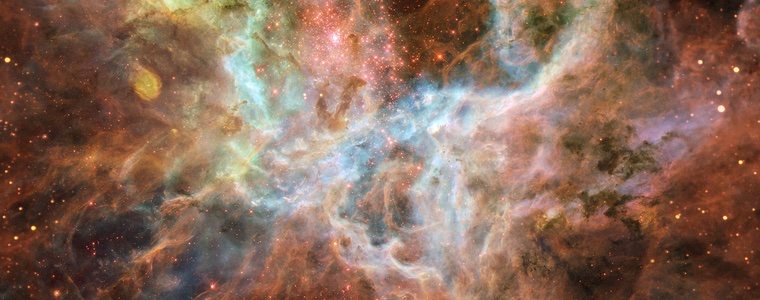 This image was taken using the Hubble Space Telescope in 1999. There are several clusters in the nebula, including the bright R136 and Hodge 301 which is an older cluster containing stars which have reached the supernova stage of their evolution. The Tarantula is the largest local area of star formation ever observed.
| ||||||||||||||||||||||||||||||||||
 OBJECT PAGE